Thermal Engineering & OEM Sourcing Directory · Metallurgical Expertise Since 1972

Aluminum Liquid Cold Plates: Comprehensive OEM Engineering Guide & Technical Procurement Directory

Architectural and industrial thermal management systems engineered to ultra-tight flatness tolerances (<0.02 mm). HAQ Aluminium provides high heat flux micro-channel, Friction Stir Welded (FSW), and vacuum-brazed liquid cold plate assemblies designed for AI hyperscale datacenters, EV battery modules, and high-power industrial inverters.

Contact Us for Thermal Calculations View Engineering Matrix
Thermal Architecture & Fundamentals

Why Global Procurement Officers & Thermal Engineers Choose Aluminum Liquid Cold Plates

As semiconductor node shrinking reaches thermal dissipation walls, high-density computing platforms, AI accelerators (such as GPU/TPU clusters), traction inverters in electric vehicles, and megawatt-scale battery energy storage systems (BESS) require far greater heat flux removal than traditional air-cooled extruded heatsinks can provide. High-efficiency Aluminum Liquid Cold Plates have emerged as the gold standard in active liquid cooling loops, delivering forced convective heat transfer coefficients order-of-magnitude higher than air conduction.

Choosing aluminum over alternative metals such as copper is fundamentally an exercise in structural power-to-weight optimization, manufacturability, and total cost of ownership (TCO). Aluminum (specifically 6061-T6 and 6063-T6 alloys) offers an unbeatable thermal conductivity-to-mass ratio ($200\text{ W/m}\cdot\text{K}$ at less than one-third the density of copper), making it the primary engineering material for mobile thermal systems, automotive EV enclosures, and rack-mounted server chassis where payload budget and shock/vibration tolerance are critical.

  • Forced liquid convection handling >100 W/cm² heat flux densities
  • 66% structural weight reduction compared to pure copper cold plates
  • Internal fluid channels optimized for minimal fluid pressure drop ($\Delta P$)
  • Full chemical compatibility with Ethylene Glycol/Water (EGW) & PGW fluids
Request Technical Specification Sheet
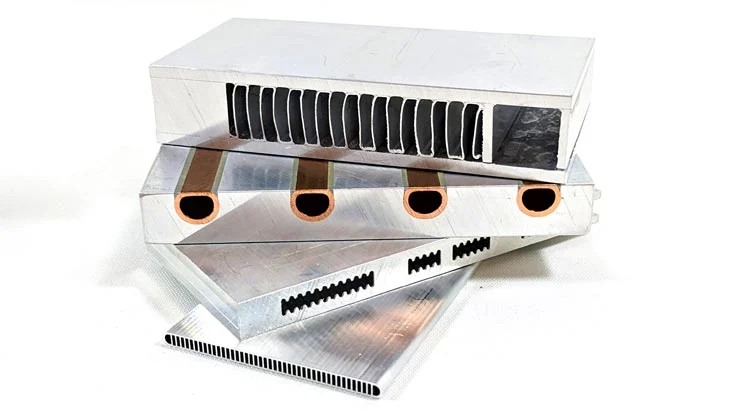
High performance precision aluminum liquid cold plate extrusion and assembly
53Years of Engineering Excellence
Manufacturing Engineering

Comparing Liquid Cold Plate Manufacturing Technologies

Understanding the metallurgical difference between Friction Stir Welding (FSW), Vacuum Brazing, Embedded Tubing, and Extruded Channel architectures is crucial to optimizing performance against production budgets.

Methodology 01

Friction Stir Welded (FSW) Cold Plates

FSW is a solid-state joining process where a rotating tool generates frictional heat to forge aluminum baseplates and cover lids without reaching melting points. This prevents porosity, maintains parent metal mechanical strength, and ensures 100% leak-proof hermetic seals capable of withstanding operating pressures over 25 bar.

Consult FSW Engineer

Methodology 02

Vacuum Brazed Liquid Plates

Vacuum brazing joins complex internal multi-layer aluminum fluid channels using a magnesium-doped filler alloy under ultra-clean vacuum conditions. Ideal for intricate micro-channel geometries, internal pin-fin arrays, and complex internal manifold routings where zero flux residue is strictly mandatory.

Explore Vacuum Brazing
Methodology 03

Embedded Tube (Tubed Cold Plates)

Copper or stainless-steel continuous tubes are mechanically press-fit into pre-machined grooves within an extruded 6063-T6 aluminum baseplate using high-pressure epoxies or mechanical staking. Eliminates fluid-to-aluminum contact when aggressive dielectric fluids or pure deionized water are specified.

Review Tubed Options
Methodology 04

Extruded Micro-Channel Plates

Direct extrusion of multi-port hollow aluminum profiles with integrated fluid passages. Combined with precision CNC end-manifold milling, extruded cold plates provide an extremely cost-effective solution for high-volume automotive battery cooling plates and linear IGBT power module chillers.

Inquire Extrusion Dies
In-House Manufacturing Integration

From Billet Extrusion to CNC Milling & Hermetic Testing — All Under One Roof

By consolidating billet homogenization, extruding, 5-axis CNC machining, surface conversion, friction stir welding, and 100% pressure-drop/helium leak testing within our Lahore manufacturing complex, HAQ Aluminium eliminates multi-vendor quality risks.

Engineering Reference Data

Engineering Matrix: Technical Specifications & Material Standards

Thermal engineers designing liquid cooling loops demand verified material properties, precise flatness specs, and proven pressure ratings. The table opposite details HAQ Aluminium's standard liquid cold plate manufacturing envelope.

Every batch is supplied with chemical analysis, Webster hardness verification, surface roughness measurement (Ra), and helium mass spectrometer leak detection certificates ($1 \times 10^{-9}\text{ mbar}\cdot\text{l/s}$).

Get Custom Tolerances Confirmed
HAQ Aluminium OEM Liquid Cold Plate Manufacturing Range
Engineering Parameter Standard Manufacturing Specification
Primary Billet Alloys 6061-T6, 6063-T6, 6082-T6, 1050/1100 (High-Purity Thermal Baseplates)
Thermal Conductivity 160 – 205 W/m·K (alloy dependent)
Joining Technologies Friction Stir Welding (FSW), Vacuum Brazing, CAB Brazing, TIG/MIG, Staked Tube
Surface Flatness Tolerance Up to 0.02 mm per 100 mm² (post-fly cutting / CNC machining)
Surface Roughness (Ra) Ra 0.4 µm to Ra 1.6 µm at thermal interface surfaces
Max Operating Pressure Up to 30 Bar (435 PSI); Burst Pressure testing >60 Bar
Leak Rate Verification Helium Mass Spectrometer Leak Detection down to 1×10⁻⁹ mbar·l/s
Surface Treatment / Finish Chromate Conversion (MIL-DTL-5541 Class 3), Anodizing (10–25 µm), Electroless Nickel
Coolant Compatibility EGW (Ethylene Glycol/Water), PGW, Dielectric Liquids (3M Novec, Fluorinert), DI Water
Fluid Interface Connections NPT Threads, SAE J1926 ORB ports, Barb fittings, Quick Disconnect (CPC/Staubli)
Product Application Matrix

Recommended Aluminum Liquid Cold Plate Systems by Application

Tailored liquid thermal management architectures developed for high heat-flux environments across AI data hubs, electric vehicles, and renewable power conversion systems.

AI Data Center GPU TPU Liquid Cold Plate assembly
Computing & Datacenters

AI Data Center GPU/CPU Liquid Cooling Plates

Designed specifically for 500W–1200W+ per-chip thermal loads in rack-scale servers. Featuring ultra-fine internal pin-fin arrays and skimmed thermal contact surfaces ensuring minimum thermal contact resistance ($R_{th}$) against die covers.

Request AI Cooling Specs
EV Battery and BESS Energy Storage Liquid Cooling Plate
Automotive & Storage

EV Battery & BESS Module Cold Plates

Lightweight extruded multi-port ribbon plates and large-format FSW aluminum plates engineered to maintain uniform thermal gradient (<3°C cell-to-cell delta) across prismatic and pouch battery arrays in commercial EV buses and grid storage.

Request BESS Plate Data
High Power Industrial IGBT Inverter Liquid Cold Block
Industrial Electronics

Industrial IGBT Power Inverter Cold Blocks

Heavy-duty 6061-T6 liquid cold plates designed for megawatt solar inverters, high-speed rail traction systems, and industrial variable frequency drives (VFDs). Deep-hole drilled or vacuum-brazed to handle extreme cyclic pressure spikes.

Inquire IGBT Cold Blocks
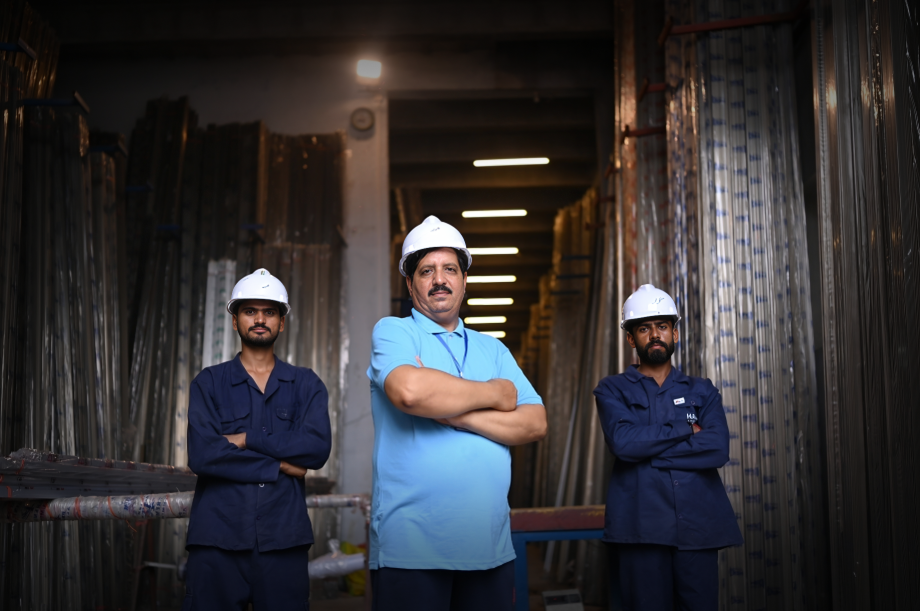
HAQ Aluminium master production floor and billet processing line
1972Foundation of Metal Expertise
Why Partner With HAQ Aluminium

53 Years of Metallurgical Precision Applied to Advanced Liquid Thermal Systems

Thermal performance relies directly on underlying metal purity, grain structure, and extrusion consistency. Founded in 1972 as iron merchants, expanding into steel re-rolling in 2008, and launching specialized extrusion operations in 2012, the HAQ Brothers group brings unmatched metallurgical depth to the liquid cooling industry.

Our vertical integration ensures that every aluminum liquid cold plate begins with certified low-porosity billets extruded on our own presses, machined on our precision CNC centers, welded on automated FSW lines, and validated in our internal NDT laboratory.

  • 1972 — Metal Trading Roots: Established foundational alloy sourcing, scrap sorting, and metallurgical science capabilities.
  • 2008 — Industrial Expansion: Commissioned heavy re-rolling mills, mastering heat treatment and structural deformation control.
  • 2012 — Extrusion Plant Launch: Established dedicated aluminum profile extrusion and surface finishing infrastructure in Lahore.
  • Today — Advanced Thermal Division: Supplying global OEMs with engineered Aluminum Liquid Cold Plates, FSW chillers, and custom profile dies.
Connect with Our Engineering Team
Hassan Ehsan Haq, CEO of HAQ Aluminium
CEO Leadership & Quality Commitment

"In Liquid Thermal Management, Zero-Defect Sealing is Not an Option — It is a Mandate."

"When liquid flows directly over multi-million-dollar AI processors or high-voltage electric vehicle batteries, a single leak or surface void is catastrophic. Our family's five-decade legacy in metallurgy taught us that true quality is engineered at the billet level and verified through rigorous testing, never assumed through marketing promises."

"By keeping die tooling, extrusion, FSW welding, surface conversion, and pressure testing completely in-house, HAQ Aluminium gives global procurement directors absolute confidence in structural integrity, dimensional repeatability, and micro-channel accuracy."

Hassan Ehsan Haq Chief Executive Officer, HAQ Aluminium
Industry Intelligence & Market Dynamics

Strategic procurement insights for supply chain managers, thermal system architects, and global purchasing organizations preparing for next-generation liquid cooling scale-up.

Trend 01 · Hyperscale Transition

The Shift From Air-Cooling to Direct-to-Chip (D2C) Cold Plates

With rack power densities exceeding 40 kW to 100 kW per cabinet in AI compute clusters, traditional air cooling has hit physical and financial limits. Procurement directors are rapidly shifting budget allocations toward Direct-to-Chip (D2C) liquid cold plates. Aluminum cold plates manufactured via FSW provide the optimum balance of weight, structural rigidity, and thermal dissipation, enabling seamless integration into 1U and 2U server blade layouts without stressing backplane connectors.

Discuss D2C Solutions
Trend 02 · Solid-State Joining

Dominance of Friction Stir Welding (FSW) Over Epoxies

Legacy tubed cold plates relying on thermal epoxies suffer from interfacial thermal resistance degrade over thermal cycling. The industry is standardizing on Friction Stir Welded (FSW) all-aluminum cold plates. FSW eliminates organic adhesives, creates a continuous monolithic metallic path between baseplate and internal fins, and dramatically reduces long-term leak risks under harsh thermal shock (-40°C to +125°C).

Explore FSW Integrity
Trend 03 · Additive & Extrusion Hybrids

Hybrid Skived & Extruded Micro-Channel Architectures

To maximize surface contact area while maintaining low fluid pressure drop ($\Delta P$), thermal engineers are specifying hybrid liquid cold plates that feature micro-skived internal aluminum fins (fin thickness down to 0.2 mm) encased inside high-strength extruded 6061-T6 frames. This hybrid design maximizes heat exchange rate per square millimeter while maintaining low volumetric production costs.

Review Micro-Channel Feasibility
Trend 04 · Low-Carbon Aluminium

Decarbonized Sourcing & Recycled Billets

Global OEMs in the automotive and enterprise tech sectors increasingly require Environmental Product Declarations (EPDs) and low-embodied-carbon aluminum raw materials. HAQ Aluminium's optimized billet scrap recycling and high-efficiency melting facilities support sustainable supply chains without compromising metallurgical purity or thermal conductivity ratings.

Request EPD & Material Audits
Verified Capacity

Extrusion & Thermal Manufacturing Metrics

0+

Metallurgical Technicians

Extrusion press operators, CNC machinists, FSW welders, and QC inspectors.

0+

Years Lineage

Continuous operational authority in metal trade, casting, and extrusion manufacturing.

0+

Major OEM Projects

Thermal management, industrial infrastructure, and structural installations completed.

0%

In-House Testing

Pressure drop verification, burst testing, and helium leak inspection performed internally.

Technical Sourcing FAQ

Frequently Asked Questions: Aluminum Liquid Cold Plates Procurement

Detailed answers to critical engineering, manufacturing, metallurgical, and supply chain questions asked by global buyers and thermal designers.

While pure copper offers higher intrinsic thermal conductivity (~390 W/m·K vs ~200 W/m·K for 6061 aluminum), Aluminum Liquid Cold Plates deliver decisive commercial and structural advantages: 1) Weight Savings: Aluminum is ~66% lighter than copper ($2.70\text{ g/cm}^3$ vs $8.96\text{ g/cm}^3$), making it essential for aerospace, electric vehicles, and rack weight-restricted datacenters. 2) Manufacturability: Aluminum can be high-speed extruded into complex multi-port channels and joined via Friction Stir Welding (FSW) at a fraction of the machining cost of copper. 3) Cost-Effectiveness: Raw aluminum raw material costs are significantly lower and less volatile than copper, providing predictable bill-of-materials (BOM) budgeting for mass production runs.

Galvanic corrosion occurs when aluminum is in electrical contact with a more noble metal (such as copper) in the presence of an electrolyte. We mitigate this through three engineered strategies: 1) Fluid Specification: Utilizing non-conductive dielectric coolants or inhibited Ethylene Glycol/Water (EGW) mixtures containing organic acid technology (OAT) corrosion inhibitors. 2) Surface Conversion: Applying MIL-DTL-5541 Class 3 chromate conversion coating or specialized anodizing inside internal channels where specified. 3) Monolithic All-Aluminum Loops: Designing all-aluminum liquid loops including aluminum cold plates, quick-disconnect fittings, and heat exchangers to completely eliminate dissimilar metal couples.

Every single aluminum liquid cold plate produced by HAQ Aluminium undergoes a rigorous multi-stage QA protocol: 1) Hydrostatic / Pneumatic Proof Pressure Testing: Cold plates are pressurized up to 1.5× to 2.0× operating pressure (typically 10–30 bar) under water to verify structural weld joint strength. 2) Helium Mass Spectrometer Leak Detection: Vacuum-enclosed helium leak testing capable of detecting micro-fissures down to $1 \times 10^{-9}\text{ mbar}\cdot\text{l/s}$. 3) CMM Dimensional Inspection: Verification of mounting hole locations, port threads, and thermal contact surface flatness (<0.02 mm). Mill test certificates and leak test logs accompany every export shipment.

The choice of surface finish depends on thermal contact resistance ($R_{th}$) requirements and environmental exposure: 1) Bare Fly-Cut / Machined Aluminum: Achieves lowest thermal resistance when paired with high-performance thermal interface materials (TIM). 2) MIL-DTL-5541 Class 3 Chromate Conversion: Provides thin, electrically conductive corrosion protection without compromising thermal transfer. 3) Electroless Nickel Plating: Excellent for harsh chemical environments and allows soldering directly to the baseplate. 4) Selective Anodizing: Anodizing external structural surfaces while keeping thermal contact pads bare or chromated.

Yes. Our in-house tool room designs and manufactures custom H13 steel extrusion dies for specialized multi-port hollow profiles, internal internal rib structures, and fluid manifold shapes. Die tooling is typically completed within 7–10 working days, followed by sample extrusions and first-article dimensional inspection (FAI) before mass production approval.

We manufacture four primary internal flow geometries: 1) Extruded Multi-Port Channels: Parallel rectangular passages extruded directly into the profile base. 2) CNC Machined Serpentine Channels: Continuous smooth-radius fluid paths milled into the baseplate prior to FSW lid sealing. 3) Pin-Fin / Micro-Matrix Arrays: Machined or skived high-density pin structures that break up fluid boundary layers for maximum heat transfer coefficient. 4) Gun-Drilled Deep Holes: Straight internal fluid passages drilled through solid billet plates with plugged cross-over manifolds.

For standard extruded base profiles, MOQs start as low as 50 units. For custom die extrusions and dedicated FSW production runs, typical initial orders start around 300 to 500 kg of finished profile equivalent. Tooling and prototype sampling take 2 to 3 weeks; full mass production orders ship within 3 to 4 weeks depending on surface treatment and packaging specifications.

Machined thermal surfaces are coated with removable protective PE films, individual cold plates are vacuum-sealed in VCI (Vapor Corrosion Inhibitor) bags with desiccant packs, fitted into custom EPE foam trays, and packed inside reinforced export wooden cases or heavy-duty cardboard boxes loaded onto ISPM-15 compliant pallets.

Rigorous QA Standards

Certified Metallurgical & Leak Testing Protocols

Documented traceability from raw billet composition to final pressure-drop and thermal impedance verification.

HAQ Aluminium Quality Management Certification

Material Integrity & Dimensional Control

Spectrographic alloy chemical verification, Webster & Brinell hardness testing, CMM dimensional measurement, and surface profile analysis according to EN 12020-2 and ASTM B221 standards.

Surface finish and pressure testing laboratory report

Hermetic Leak & Hydrostatic Burst Testing

100% in-line pressure drop inspection, hydrostatic proof-pressure testing up to 60 Bar, and helium mass spectrometer leak detection ensuring zero fluid ingress into electronic environments.

Global Supply Chain Partner

Trusted by Industrial Leaders & Infrastructure Developers

Organizations that rely on HAQ Aluminium for precision profiles, structural components, and engineered heat dissipation assemblies.

  • Industrial engineering partner logo
  • Manufacturing partner logo
  • Dolmen group infrastructure logo
  • Reon Energy renewable technologies logo
  • Institutional defense client logo
  • Enterprise partner logo
  • Commercial partner logo
  • Thermal systems partner logo
  • Industrial client logo
  • Global logistics partner logo
  • Engineering client logo
  • Industrial supplier logo
  • Technology infrastructure logo
  • OEM partner logo
Direct Factory Communication

Consult Our Thermal Engineering & Die Tooling Team

HAQ Aluminium Extrusion Plant

Developing a Custom Aluminum Liquid Cold Plate Project?

Send your 3D CAD files (STEP, IGES, DWG), target thermal resistance criteria, and pressure drop specs. Our thermal engineering team will provide a comprehensive extrudability analysis, FSW tool evaluation, and price quotation within 48 hours.

Contact Us